
A scientific study
When the excavations of Novae allow to understand, classify and date a very popular group of Loeschcke VIII lamps, specific to the Western area of the Lower Danube.
The current state of the lychnological researches throughout the Western part of the Lower Danube, from Singidunum (Belgrade) to Durostorum (Silistra) on the Southern bank and its hinterland, as well as, on the other side of the river, from Drobeta to Sucidava and the sites of the Oltenia hinterland, leaves much to be desired.
More precisely, we observe an alternation of sites or regions that have delivered lychnological researches with rich quantitative content (Singidunum, Viminacium, the Museums of North-West Bulgaria, Sucidava, Novae, Durostorum) contrasting with immense geographical areas that remain “terra incognita“. Moreover, in several of the catalogs mentioned, the quality is very deficient, both because of the lack of access to the available bibliography and because of the authors choice of anchoring their groups to old typologies (Ivanyi, Kuzmanov, etc.) that have demonstrated their weaknesses when used in a specific ancient site, when it comes to defining, framing and especially specifying the dating of a subtype of lamps such as the one we are dealing with here.
The Loeschcke VIII variant in question differs very clearly from its contemporary ‘competitors’ by its robust constitution, ideal to avoid breakage in case of road supplies, as well as by its particular characteristics. Such lamps are equipped with a reservoir and above all with a spout both being a little longer than the ones of the “standard shapes”. They have systematically a molded handle – almost never pierced – and, above all, have their discus decorated with a simple and repetitive motif: a rosette – very rarely, one also finds lamps decorated with an animal motif or a shell. Finally, the decoration of the slightly convex shoulder generally consists of printed discs or, in the most elaborate variants, a vegetal frieze ranging from the most naive representations to almost perfect copies of the frieze of grape bunches and vine branches, inspired by contemporary Micro-Asiatic lamps, an ornamentation that would quickly seduce Attic workshops, particularly Corinth, from the 3rd century AD onwards.
Typically, to be clear, this is the subtype that Slavica Krunic has separated from the other lamps with rounded nozzle. She divided it, for Singidunum, into two types: the “Type VIII, Local Variant 3.2”, the oldest one, dated from the end of the 2nd to the 3rd century AD. (Krunic 2005, p. 56), and the “Type XV”, dated from the 3rd century (Krunic 2005, p. 70).
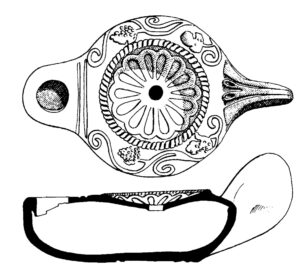
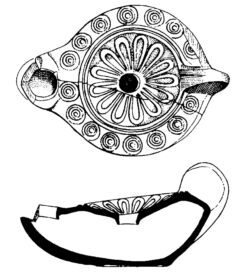
Fig 1: Slavica Krunic’s types VIII (local variant 3.2) and XV (Krunic 2005)
At Viminacium, Miomir Korac integrated the lamps of this subtype into his vast group called (Loeschcke) VIII variant K, a group with no real coherence except for its chronology, fixed between the reign of Galba and that of Marcus Aurelius (Korac 2018, p. 203). At the National Museum of Archaeology in Sofia, our lamp type shape roughly corresponds to the type Kuzmanov 21, variant 2a, dated from the 3rd to the beginning of the 4th century AD. (Kuzmanov 1992, pp. 22-23). In the old catalog of the early Roman Imperial lamps of Novae, it constitutes the group 4, variant A of Maria Cicikova, dated from the second half of the 2nd to the 3rd century AD. (Cicikova 1987, p. 159).
At Durostorum, such lamps build the type VIII of Crişan Muşeţeanu and Dan Elefterescu, dated from late 3rd to mid 4th century AD (Muşeţeanu, Elefterescu 1983, pp. 122-123; see also Muşeţeanu, Elefterescu 2006, n. 2-3 pl. 127 and Muşeţeanu, Elefterescu 2008, p. fig. 8 (I.b.4), p. 143).
As for many other forms of lamps, the excavations in the Western Sector of Novae (mission of the Antiquity of Southeastern Europe Research Centre of the University of Warsaw, directed by Prof. Piotr Dyczek) question both the typology and the chronology of this precise subtype, since they are associated with all the other materials of various contexts within a stratigraphic excavation providing precise and short dating. The first surprise consists in the dating of such lamps. In Novae, in their simple “canonical” form, four lamps and two fragments (n. 1-6) were found in contexts belonging to the phase precisely framed between 101 and 121 A.D. : their production and diffusion thus begins well before the most cautious of the above-mentioned proposals. Within this group, only one fragment (n. 7) is an exception, since it comes from a much later context (AD 222-238).
Therefore, several considerations and their corollary of questions, obviously emerge:
- What is the date and where is the “place of birth” of these lamps as well as which was the whole production time of the original lamps?
- When did the adoption of this type and the birth of numerous variants, discovered among the productions of the great ceramic workshops (Pavlikeni, Boutovo) started? Those industries, producing many types, often contemporarily, were born around 150 AD with the primary aim of supplying the town of Nicopolis ad Istrum and the duration of their production (hence the chronology proposed by Cicikova).
- What could have motivated the rebirth of the original type, around 250 AD, in the workshops of Durostorum-Ostrov, unearthed and perfectly dated by the Romanian excavations (hence the chronology proposed by Kuzmanov), exactly at the moment when Novae was reduced to nothing by the invasion of the Goths?
- The first lamps, whose new dating is from now on fixed by the excavations of Novae
The lamps unearthed Novae (see catalogue at the end of the article), mostly found in the valetudinarium, are of the simplest type: a rosette of 10 to 16 petals adorning the medallion and, for the most part, discuses imprinted on the shoulder (n. 1-4, 7) while only one fragment (n. 6) is decorated with a naively rendered vegetal frieze. The round and flat base is rarely defined by a circular raised rim (n. 1); most often it is decorated with a small circle printed in the center (n. 2, 3, 5) or simply has no decoration (n. 4). As can be seen by the major differences in both clay and slip, our seven specimens were manufactured by several workshops in the region, impossible to locate or even define with certainty due to the lack of clay analyses.
If we come to the chrono-typological aspect, the specimens of Novae, in particular the four intact lamps (n. 1-4), find several exact parallels, the first one discovered during ancient excavations on the same site (Cicikova 1987, n. 55, p. 160 and pl. 7). Further East, two specimens are found in Raetiaria, (Torbov 2014, n. 119, p. 38 and n. 6 pl. 8; n. 157, p. 44 and n. 11 pl. 9), three specimens as well the upper part of a mold, in Sucidava (Gherghe, Cojoc 2011, n. 8-9 and 11 p. 37 and pl. 1, 2, 45; mold: n. 204 p. and pl. 42); and one specimen in Viminiacium (Korac 2018, n. 150r, pl. 241), where we can find also an identical parallel to our fragment n. 6 (Korac 2018, n. 150r, pl. 241).
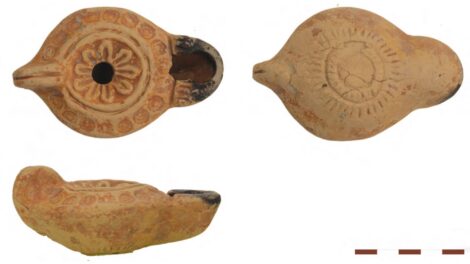
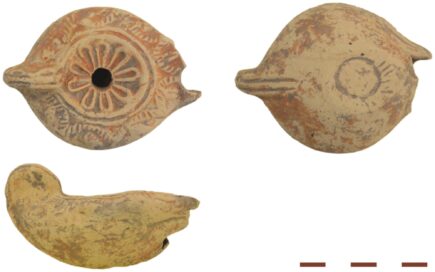
Based on the locations of our exact parallels, as well as on the dating of the generic type at Viminacium, where Miomir Korac designates as the beginning of production the ephemeral reign of Galba (68-69 AD), a well delimited geographical area begins to become clear for the early types of our variant, with Viminacium as its westernmost end and Novae as its easternmost one.
- The birth of Nicopolis ad Istrum and the appropriation of this lamp variant by the workshops of Pavlikeni and Boutovo.
Far from imitating these “rather poor” predecessors, the lamps of Pavlikeni (cf. in primis Vladkova 2011) and Boutovo (cf. Sultova 1991), founded around the middle of the 2nd century A.D., innovated by substituting to the full discus rosette with various floral or geometrical decorations combined, but above all by decorating the shoulder with a wide variety of ornaments, most often consisting of friezes, either vegetal or geometrical.
It is this affinity that led Maria Cicikova, for Novae, to propose an overly advanced dating of the “original variant” of the lamps, while she was already understanding the functioning of the adoption of the type by the micro-regional workshops, i.e. regional lamps she classified in her group 4, variant C, dated from the second half of the 2nd to the 3rd century AD. (Cicikova 1987, p. 159).
On the contrary, Gheorghi Kuzmanov, a fine connoisseur of Durostorum, will give them a dating conforming to that of the Silistra findings, whereas the individuals of his type 21, variant 2a are all from Escus, Raetiaria and Novae, thus to be classified among the productions of Pavlikeni and Boutovo, which are known to us as having been popular even on the other side of the Balkan chain, as far as Stara Zagora and Plovdiv.
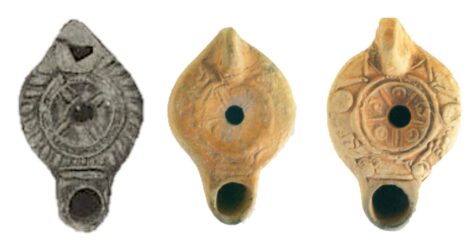
One of the lamps discovered in Boutovo (Sultova 1991, n. 24) and two lamps discovered in Pavlikeni (Vladkova 2011, nn. 31-32, p. 127)
- The disaster of the First Gothic War and the revival of type at Durostorum
During the invasion of the Goths, in 250-251 AD, Novae, Nicopolis and their territories were destroyed, raided, looted, hence practically annihilated. Fortunately, Durostorum did not suffer any damage, as it was not on the route of King Cniva’s campaign. On the outskirts of the military camp, the ceramic industries, intact, could hence continue to produce thousands of lamps and it was at this precise moment that, in addition to the Firmalampen, these factories would add to their range of production the type referred to here. Also, from the middle of the 3rd to the middle of the 4th century AD, they will faithfully take over… the initial, simplest variant of our subtype.
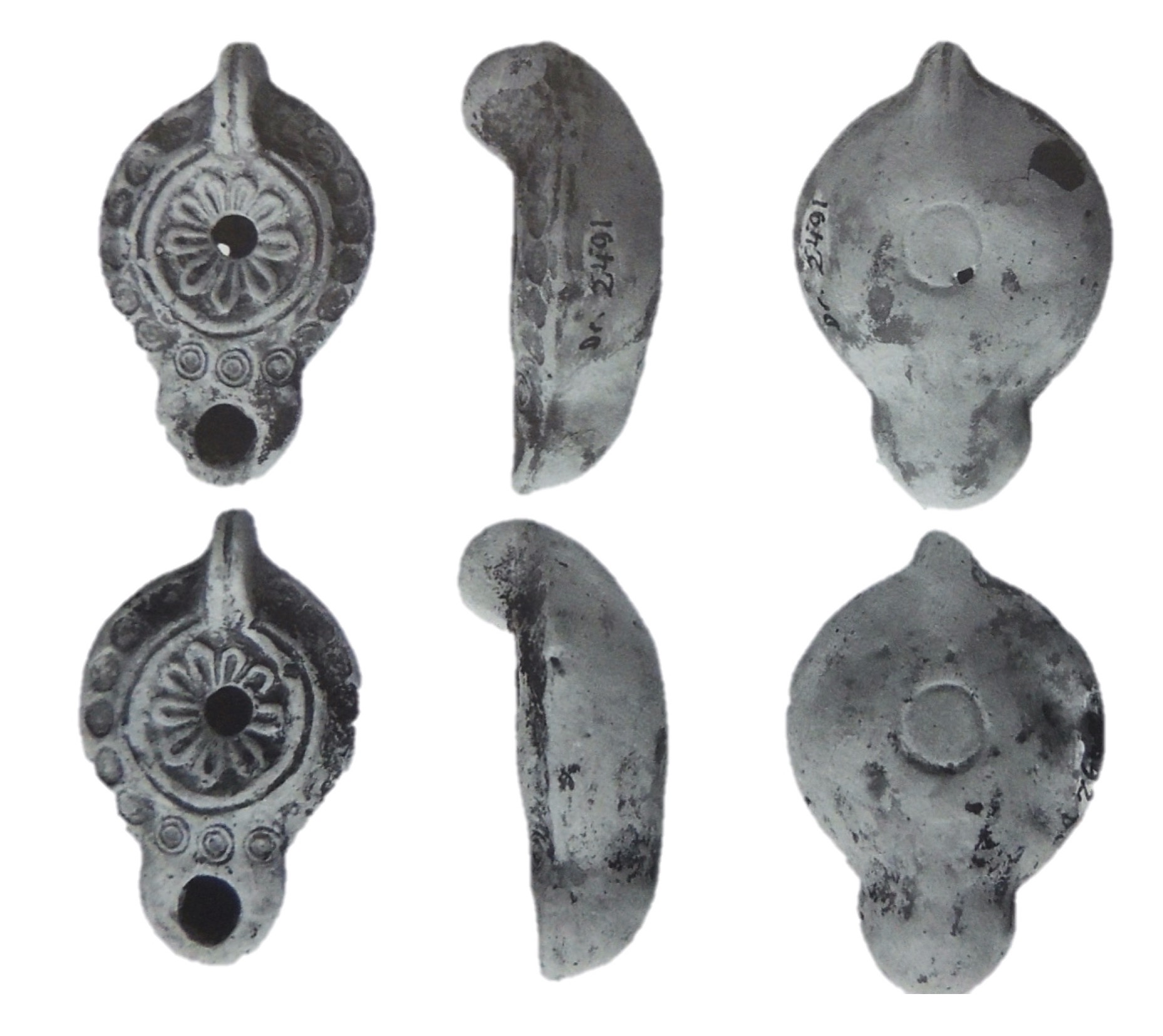 Lamps unearthed at Durostorum (workshops of the Canabae) (Museteanu, Elefterescu 2008a).
The simple rosette on the discus, the shoulder adorned with imprinted discuses, the small circle imprinted on the base … in short, we witness an identical reproduction of the “primordial type” of those lamps such as they were used at Novae nearly 150 years before.
In conclusion, the question remains whether this “archaism” – a fairly frequent phenomenon in the Eastern part of the Empire, from Alexandria to Chersonesos – is really one, or whether we are still missing a link that would allow us both to determine a long period of production of the “simple” type and to consider iconographic innovations as exclusive to the productions of Boutovo and Pavlikeni, where a very large number of ceramic workshops, barely discovered, have yet to be excavated.
For the time being, only the two consecutive variants of Singidunum attest to a continuity of this subtype, although the 3rd century variants are more richly decorated on the shoulder. The solidity of the Danubian network of trade and hence of contacts as well of the supply of large military centers, such as Durostorum, could therefore be this “link”, but this is only a possibility that only future discoveries could raise to the rank of a hypothesis. This idea is reinforced nevertheless by our last fragment (n.7), belonging the standard early type and perhaps produced locally – since it is insensitive to the innovative decorations peculiar to the above-mentioned workshops – while being dated a few decades before the city’s devastation by the Goths.
Nevertheless, this specific variant, to be included in the immense “Loeschcke VIII” group, demonstrates once again that, like Dobrogea, during the High Empire there were several areas with a true ceramic unity, with their specificities. We can easily see such a koinè and its common lychnological fashions in the sites of the Western part of the Lower Danube, running on all the Danubian lands located between Singidunum and Novae.
In this context, Durostorum, further East, constitutes a special case, adopting and producing, apart from the standard imperial types, a number of types specific to the fashions attested in centers further upstream, as well as other types, popular in the sites of the Danube Delta and the Black Sea coast.
SELECTED BIBLIOGRAPH
Cicikova, M. 1987 Pottery lamps from Novae (Lower Moesia), 1st-3rd century, in Recherches sur la culture en Mésie et en Thrace (Bulgarie) (= Bulletin de l’Institut d’Archéologie 37), Sofia, 153-172
Gherghe, P., Cojoc, M. 2011, Opaițele romane şi romano-bizantine descoperite în teritoriul Sucidavei, Craiova
Korać, M., Oil-lamps from Viminacium (Moesia Superior), Institute of Archaeology, Monographies 67 (2 vol.), Belgrade 2018
(online download/Academia): click on the Text or Plates volume.
Krunić, S. 2005, Pregled antičkih svetiljki Singidunuma, in Singidunum 4 (2005), 45-104
Muşeţeanu, C., Elefterescu, D. 1983, Lampes romaines de Durostorum, in Dacia 27, 109-128
Muşeţeanu, C., Elefterescu, D. 2008 (b), Les ateliers de lampes de Durostorum, in Gudea, N., Roman C.-A. (eds.), Lychnological Acts 2 Cluj-Napoca, 183-185 + pl. 125-127.
Muşeţeanu, C., Elefterescu, D. 2008 (b), Les ateliers de lampes de Durostorum, in Avram, A.. Lungu, V. Neagu, M. (eds.),ΦΙΛΙΑΣ ΧΑΡΙΝ. Mélanges à la mémoire de Niculae Conovici, Călăraşi,. 135-148
Кузманов, Г. 1992, Антични лампи. Колекция на Националния археологически музей, София
Султова, C. 1991, Глинени лампи тип ”Бутово”, Известия На ИM Велико Търново VI, 116-128
Торбов, Н. 2014, Антични лампи от Северозападна България, Враца
Владкова, П. 2011, Античен производствен център при Павликени (Долна Мизия), Велико Търново 2011